Flat face flanges are selected for equipment-sensitive and low-pressure systems, raised face flanges suit most standard industrial piping, and RTJ flanges are used in high-pressure, high-temperature, and critical service environments. The correct choice depends on pressure class, gasket type, connected equipment, and long-term sealing requirements—not on interchangeability or cost alone.
Choosing the wrong flange face can lead to gasket failure, flange damage, or recurring leakage, even when the product comes from a qualified flat face flange factory or flange manufacturer.
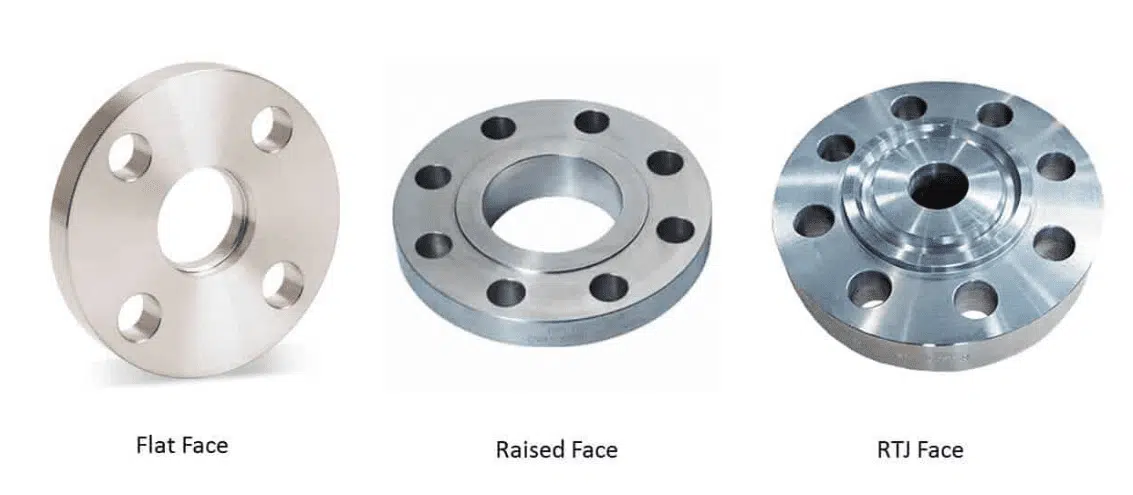
What are the main differences between flat face, raised face, and RTJ flanges?
The primary differences lie in sealing surface geometry, gasket type, and pressure capability.
Flat Face (FF): Entire flange face is flat; uses full-face gaskets
Raised Face (RF): Raised sealing surface around the bore; uses ring or spiral wound gaskets
Ring Type Joint (RTJ): Machined groove for metal ring gasket; metal-to-metal sealing
Each design is optimized for a specific range of operating conditions.
When should a flat face flange be used?
Flat face flanges are used when uniform gasket compression and equipment protection are critical.
They are typically specified when:
Connecting to cast iron or ductile iron equipment
Equipment flanges cannot tolerate bending stress
Pressure ratings are relatively low (commonly up to 300#)
Full-face gaskets are required by equipment manufacturers
A reliable flat face flange factory ensures strict flatness control, which is essential for preventing flange distortion and gasket leakage.
Why are raised face flanges the most common choice?
Raised face flanges are the default option in most ASME B16.5 piping systems.
They are preferred because:
The raised sealing surface concentrates gasket load
Sealing performance is stronger than flat face designs
They support a wide range of pressure classes
They are compatible with most steel piping systems
For general industrial service, raised face flanges provide a good balance between sealing reliability and installation flexibility.
What makes RTJ flanges different from flat face and raised face flanges?
RTJ flanges are designed for severe service conditions.
Their defining features include:
Precision-machined gasket grooves
Use of metal ring gaskets (R-type, RX, BX)
Metal-to-metal sealing under high bolt load
RTJ flanges are commonly used in:
Unlike flat face or raised face flanges, RTJ connections are not forgiving of installation errors and require precise machining and torque control.
Can flat face, raised face, and RTJ flanges be connected together?
They are not directly interchangeable without modification.
Flat face flanges should not be bolted to raised face flanges unless the raised face is machined flat
RTJ flanges require matching groove geometry and compatible ring gaskets
Mixing flange types without engineering review can introduce bending stress or sealing failure
This is why correct selection at the design stage is far more effective than adapting components later.
How does gasket selection influence flange choice?
Gasket compatibility is a deciding factor.
| Flange Type | Gasket Type | Sealing Mechanism |
Flat Face | Full-face gasket | Uniform surface compression |
Raised Face | Spiral wound / ring gasket | Concentrated gasket stress |
RTJ | Metal ring gasket | Metal-to-metal sealing |
Selecting a flange without considering gasket behavior often results in leakage, even when pressure ratings appear sufficient.
Which flange type is best for high-pressure applications?
RTJ flanges are the preferred choice for high-pressure and critical service.
Raised face flanges handle moderate to high pressures effectively but rely on gasket integrity. Flat face flanges are generally limited to low-pressure systems due to their load distribution characteristics.
Pressure capability should always be evaluated together with temperature, media, and maintenance accessibility.
How do standards affect flange face selection?
Standards strongly influence which flange type is appropriate.
ASME B16.5: Raised face is standard; flat face is used for special cases
DIN / EN systems: Flat face flanges are more common in certain PN ratings
API standards: RTJ flanges dominate high-pressure oil and gas applications
Compliance with the applicable standard ensures dimensional compatibility and inspection acceptance.
How should buyers decide which flange face to specify?
The decision should be based on:
Pressure and temperature conditions
Type of connected equipment
Gasket design
Applicable standards
Installation and maintenance strategy
Working with experienced flange manufacturers—whether a flat face flange factory or full-range flange suppliers—helps align the product with real operating conditions instead of generic assumptions.
Technical Comparison: Flat Face (FF) vs Raised Face (RF) vs RTJ
| Aspect | Flat Face (FF) | Raised Face (RF) | Ring Type Joint (RTJ) |
Sealing Method | Full-face gasket compression | Concentrated gasket compression | Metal-to-metal sealing |
Gasket Type | Full-face gasket | Spiral wound / ring gasket | Metal ring gasket (R, RX, BX) |
Pressure Range | Low | Medium to high | Very high |
Temperature Capability | Limited | Moderate to high | High to extreme |
Flange Face Geometry | Completely flat | Raised sealing surface | Precision-machined groove |
Tolerance to Misalignment | Higher | Moderate | Low |
Typical Standards | DIN / EN, special ASME | ASME B16.5 | ASME, API 6A |
Installation Difficulty | Low | Medium | High |
Typical Applications | Equipment connections, utilities | General industrial piping | Oil & gas, HPHT systems |
Interchangeability | Limited | Common standard | Not interchangeable |
Choosing the right flange face improves long-term reliability
Each flange face design serves a specific purpose:
Flat face flanges protect sensitive equipment and distribute load evenly
Raised face flanges offer versatile sealing for most industrial piping
RTJ flanges provide maximum sealing integrity for extreme service
Correct selection reduces leakage risk, protects connected equipment, and lowers lifecycle costs. In engineered piping systems, the right flange face is not an option—it is a requirement for safe and reliable operation.
FJGX
Leading Manufacturer of Stainless Steel Piping Solutions.