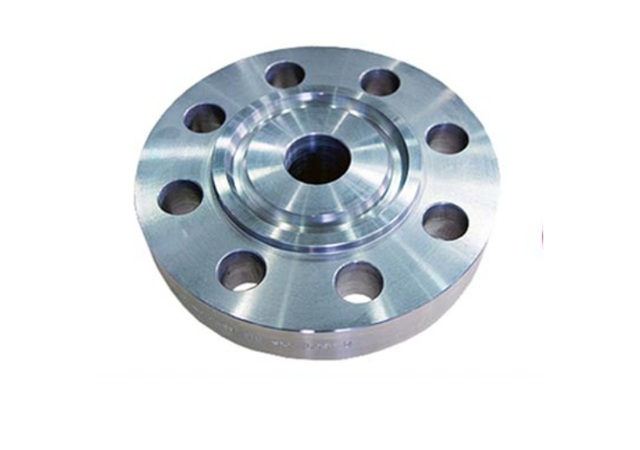
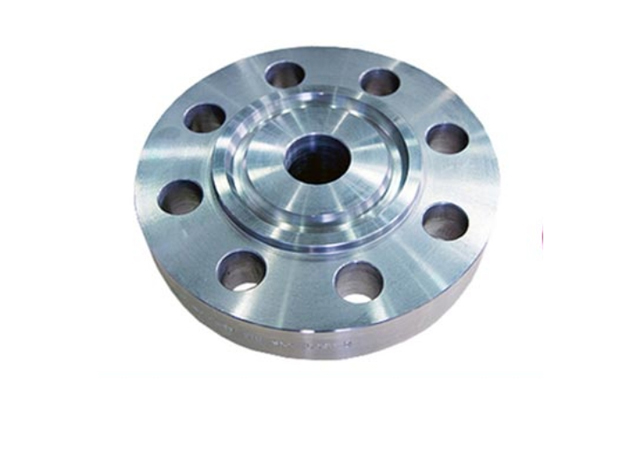
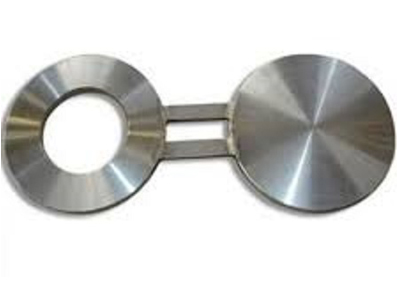
Sizes: ½” to 24”, pressure ratings 300# to 2500#.
RTJ Flange Standards: ASME B16.5, API 6A.
Materials: ASTM A182 F316, A105, and duplex steel.
Used with R-type or RX ring gaskets. Compatible with weld neck and blind flanges.
| Specification | Description |
Product Name | Ring Type Joint Flange (RTJ) |
Size Range | ½” to 24” |
Pressure Rating | 300# to 2500# |
Standard Compliance | ASME B16.5, API 6A |
Materials | ASTM A182 F316, A105 Carbon Steel, Duplex Steel |
Gasket Type | R-type or RX ring gaskets |
Compatible Flange Types | Weld Neck, Blind |
Connection | Welded |
Temperature Range | Depends on material and service conditions |
Face Type | Ring Type Joint groove |
Surface Finish | Machined as per standard |
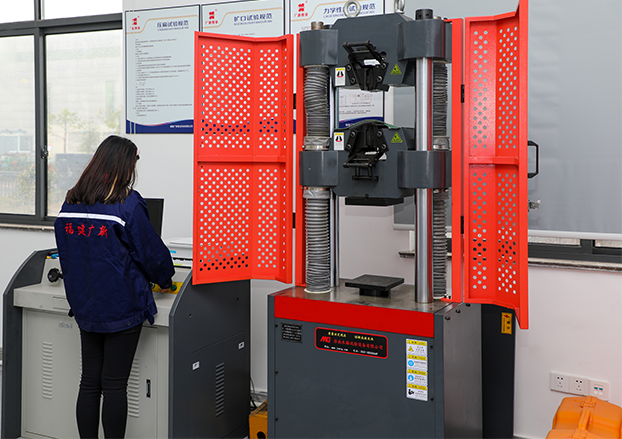
Testing | Hydrostatic testing; NDT on request |
Certification | Material Test Reports (MTR); third-party inspection optional |
Applications | Oil & gas, high-pressure piping systems, refineries, petrochemical plants |
Customization | Sizes, materials, and pressure ratings to customer requirements |
RTJ flanges are designed for high-pressure and high-temperature environments and are used with R-type or RX ring gaskets for metal-to-metal sealing.
In industrial piping systems, RTJ flange vs RF flange (Raised Face flange) are two widely used sealing face designs. While both are standardized under ASME B16.5, they differ significantly in sealing mechanism, pressure capability, and application environment. Understanding these differences helps engineers select the correct RTJ flange vs RF flange e for specific operating conditions.
A ring type joint flange (RTJ flange) features a precision-machined groove that accommodates a metallic ring gasket. When bolts are tightened, the ring plastically deforms into the groove, forming a highly reliable metal-to-metal seal suitable for extreme pressure and temperature environments. In contrast, RF flanges use soft gaskets such as spiral-wound, PTFE, or graphite that are compressed against the raised sealing surface to achieve sealing.
| Feature | RTJ Flange (Ring Type Joint) | RF Flange (Raised Face) |
|---|
| Sealing mechanism | Metal ring gasket compressed in groove | Soft gasket compressed on raised face |
| Typical pressure class | Class 600–2500 | Class 150–300 (most common) |
| Temperature capability | Very high, suitable for extreme conditions | Moderate, limited by gasket material |
| Applications | Oil & gas, wellhead, high-pressure pipelines | Chemical plants, utilities, general piping |
| Cost | Higher due to precision machining | Lower and widely used |
Because RTJ flanges provide superior sealing performance in critical services, they are commonly used in upstream oil & gas, offshore platforms, and high-pressure process systems. As professional RTJ flange suppliers and manufacturers, we provide high-precision ring type joint flange solutions designed for demanding industrial environments and compliant with international RTJ flange standards.
What are RTJ flange types?
RTJ flange types refer to different flange face configurations that use a ring-type joint groove (R, RX, or BX) to achieve a metal-to-metal seal for high-pressure applications. These RTJ flange types provided by professional rtj flange manufacturers are typically applied to weld neck, blind, or slip-on flanges depending on piping design requirements.
Do RTJ flanges use gaskets?
Yes, RTJ flanges use metallic ring gaskets (such as R, RX, or BX types) that sit in a machined groove and deform under bolt load to create a high-integrity seal. This sealing method is designed for extreme pressure and temperature conditions where soft gaskets are not suitable.
What is the application of RTJ flange?
The RTJ flange application is mainly in high-pressure and high-temperature piping systems such as oil & gas, offshore platforms, refineries, and petrochemical plants. It is used where a leak-proof, metal-to-metal seal is required for safety and reliability under extreme operating conditions.